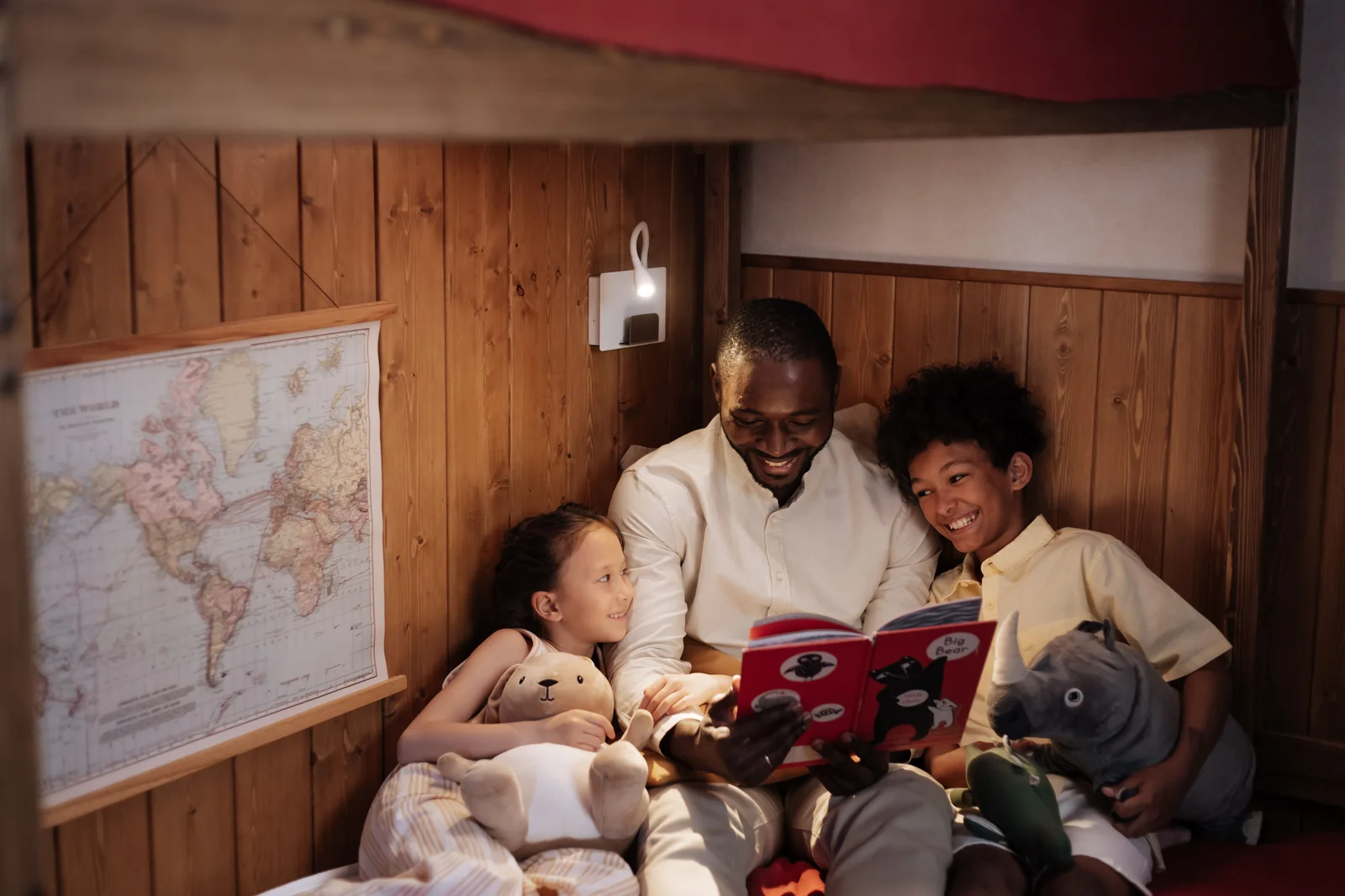
A good personalized bedtime story does not need a child’s full name, school, birthday, address, or daily schedule. It needs only a few safe ingredients: something the listener enjoys, a make-believe setting, a manageable problem, and a warm ending.
For example, turn “likes frogs and blueberry pancakes” into a tale about a young explorer helping a frog cook breakfast for the moon. The details feel personal, but they do not identify the child.
The trick is to write for the ear rather than the page. Keep the opening brisk, repeat one satisfying phrase, give the reader room to change their voice, and let the final third grow quieter.
Start with safe personalization#
Personalization works when the listener recognizes a preference, habit, or joke. It does not require private facts.
Useful details include:
- A favorite animal, color, food, toy, or imaginary creature
- A broad interest such as space, dancing, trucks, baking, or bugs
- A harmless character trait such as curiosity or patience
- A made-up nickname used only for the story
- A gentle challenge, such as feeling nervous about thunder or learning to share
Avoid entering a child’s full name, precise location, school, contact information, photograph, voice recording, or other identifying material into an online service. The FTC’s explanation of personal information includes names, street-level location data, contact details, and files containing a child’s image or voice. Its guidance is aimed at online-service operators, but the definitions offer parents a useful privacy checklist too. See the FTC’s COPPA FAQ.
A fictional role can replace a real name without weakening the connection. Try “Captain Clover,” “Doctor Doodle,” or “the Keeper of the Blue Socks.” If two children are listening, give each one a distinct job. One can spot clues while the other speaks to animals.
Build the story from four bedtime beats#
A simple structure prevents the adventure from sprawling just when everyone is tired.
1. Open with a small surprise#
Introduce the familiar interest and disrupt it quickly:
Every night, Pip counted the stars. Tonight, one of them counted back.
The listener immediately knows what is unusual. There is no long explanation to remember.
2. Set one clear mission#
A bedtime protagonist should be able to say what they need to do in one sentence: return a lost cloud, teach a dragon to whisper, or find the moon’s missing slipper.
Keep the danger mild for younger listeners. A mixed-up delivery, a stubborn door, or a hiccupping giant can create tension without making bedtime frightening.
3. Repeat, then vary#
A refrain gives the child a line to anticipate:
“Soft paws, slow steps, moonlight knows the way.”
Use it three times. The first establishes the pattern. The second invites participation. The third can change slightly to mark success: “Soft paws, slow steps, moonlight brought us home.”
Repetition lets a child predict what comes next and join in without being put on the spot. The reader can add variety by emphasizing one word, slowing down, or dropping to a whisper. There is no need to stage an elaborate performance.
4. Lower the energy before the final line#
Do not solve the problem and stop instantly. Give the characters time to return home, put things away, notice a quiet sound, and settle down.
Compare these endings:
The rocket landed. The end.
The rocket clicked, cooled, and tucked in its silver wings. Inside, one small astronaut yawned. Outside, the stars kept watch.
The second provides a verbal runway into sleep.
An invented worked example#
Personalization inputs: favorite animal: frog; favorite food: blueberry pancakes; preferred role: inventor; bedtime mood: cozy; age range: approximately four to seven. These details and the story below are invented.
The Frog Who Flipped the Moon#
On the edge of a silver pond lived an inventor called Moss.
Moss built useful things.
A spoon that stirred by itself.
A hat that knew when it was raining.
And a tiny brass bell that rang whenever somebody needed a snack.
Ding-a-ling!
One night, the bell rang so loudly that Moss bounced right out of bed.
“Somebody,” said Moss, pulling on two blue boots, “needs a very important snack.”
At the pond waited a round green frog. He wore a chef’s hat and carried an empty plate.
“The moon is hungry,” the frog whispered.
Moss looked up. The moon did seem thinner than usual.
“What does a moon eat?”
“Blueberry pancakes, of course.”
So Moss packed flour, milk, blueberries, and the self-stirring spoon. The frog brought a pan. Together they climbed the tallest hill, where the moon hung low enough to smell the berries.
But there was one problem.
The pan had no fire beneath it.
Moss opened the inventor’s box. Inside were three things: a button, a feather, and a sock with yellow stripes.
“Button, feather, stripy sock,” Moss said. “Wake the warmth around the clock.”
The button clicked.
The feather tickled.
The sock gave a tiny sneeze.
Fffff-POOF!
A warm blue flame appeared.
The frog poured one pancake into the pan. It bubbled. It wobbled. It grew as wide as a wagon wheel.
“Ready to flip?” asked Moss.
“Ready,” said the frog.
“Flip it low, flip it light, send a pancake through the night!”
They flipped.
The pancake sailed past an owl.
It sailed over a cloud.
It landed on the moon with a soft, buttery plop.
The moon took one bite and glowed brighter.
Another bite, brighter still.
Then the moon smiled so widely that a blueberry rolled down its chin and dropped into the pond below.
Plink.
“Thank you,” hummed the moon. “That was exactly enough.”
Moss packed the spoon. The frog folded the pan. The blue flame curled itself into a warm little bead and went back into the box.
Down the hill they walked.
Past the sleepy owl.
Past the folded cloud.
Past the pond, where one blueberry floated like a tiny boat.
“Flip it low, flip it light,” whispered Moss.
“Time to say a soft good night,” whispered the frog.
Moss climbed into bed. The blue boots rested beside it. Outside, the moon shone round and full.
And the brass snack bell did not ring again until breakfast.
Edit with your ears#
Read the draft aloud once before bedtime. Mark every place where you stumble, run out of breath, or cannot tell who is speaking. Shorten those lines.
A practical sound edit has four passes:
- Breath: Split sentences that feel too long to say comfortably.
- Mouth: Replace awkward clusters of words. “The sixth small squirrel” may look fine and still tangle the tongue.
- Voice: Give each major character one audible distinction, such as a whisper, a slow rhythm, or a favorite phrase.
- Landing: Make the final few paragraphs quieter and simpler than the middle.
Reading aloud exposes problems that silent editing misses. Guidance from The Author Network similarly recommends listening for stumbles, flat lines, breathless sentences, and natural moments of anticipation. Perfect rhyme is not required. In fact, forced rhyme often produces strange grammar or words that are too advanced for the listener.
Participation should also remain optional. Pause before the final word of a familiar refrain, but supply it if the child is tired. Questions can be gentle rather than quiz-like: “Should they open the tiny door?” is more playful than testing whether the listener remembers a detail.
Using a book generator without losing your voice#
Nellie, published by Buzzle LLC, supports AI-assisted fiction, illustrated-book, and audiobook workflows. Because this article is Nellie-owned commentary, it is important to be clear about the tradeoff: a generator can expand a premise or help structure a longer book, but it cannot know your family’s comfort level, privacy boundaries, or bedtime mood. Adults should review generated manuscripts before reading or distributing them.
If you use Nellie or another writing service, provide a compact, privacy-conscious prompt:
Write a cozy read-aloud story for ages five to seven. The hero is called Captain Clover and loves frogs and blueberry pancakes. Include one mild problem, a refrain repeated three times, playful sound words, and a calm ending. Do not include real places, schools, surnames, or contact details.
Nellie’s FAQ explains its book-generation workflow. Treat any output as a draft. Check vocabulary, emotional intensity, continuity, and how every sentence sounds aloud.
For tonight, start smaller: choose one favorite thing, invent one silly mission, and write a line the child can repeat. Once that refrain works, the rest of the story has something to march to, then something to whisper on the way to sleep.