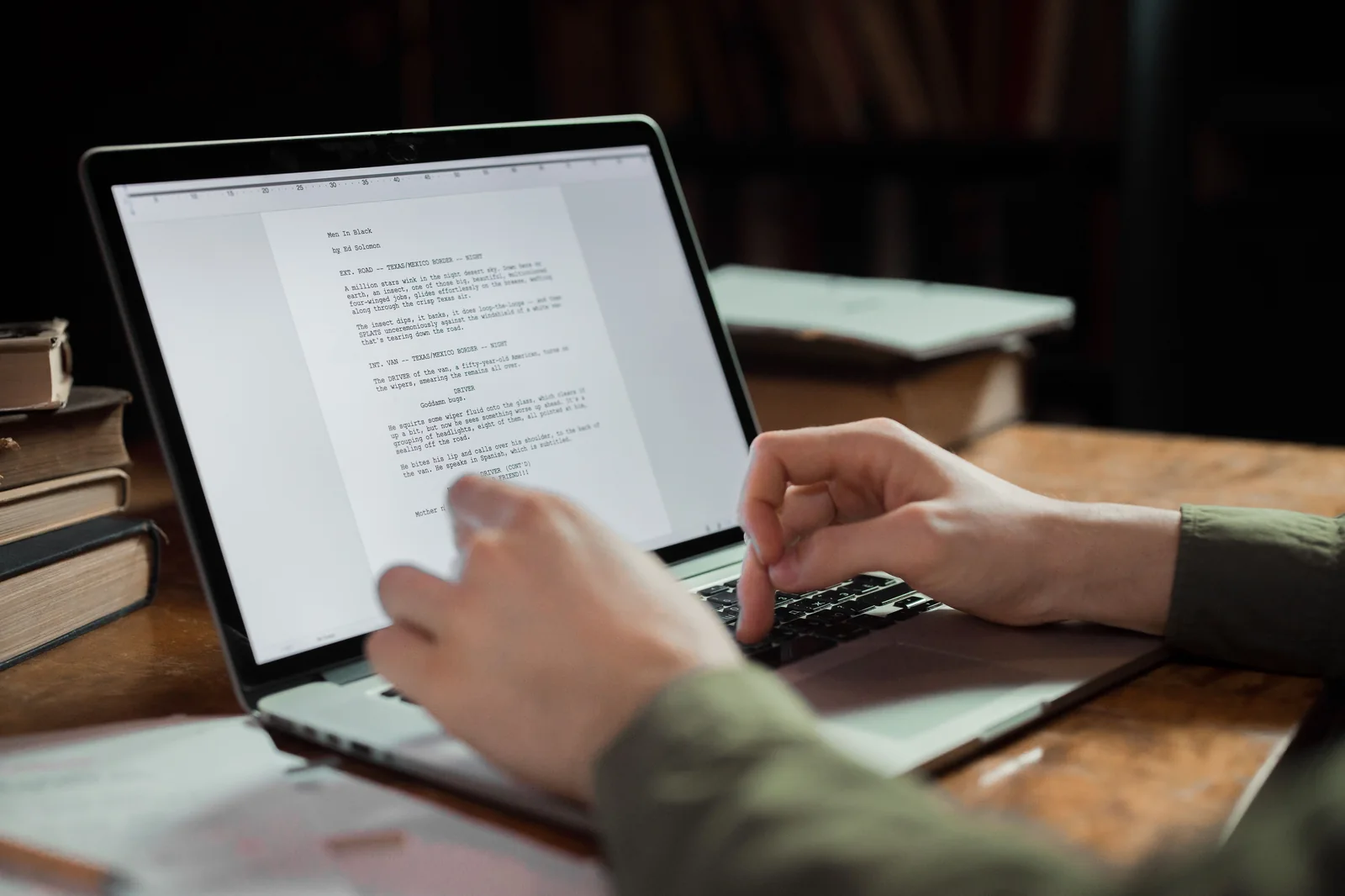

The practical difference is how often you want to take the wheel. Nellie is designed to generate a complete, full-length book from a prompt in one run. Sudowrite is an interactive fiction-writing environment built around outlining, drafting, expanding and revising individual passages, scenes and chapters.
Choose Nellie if you want to define the book, generate an end-to-end draft and then revise the resulting manuscript. Choose Sudowrite if you want to make creative decisions throughout drafting, request alternatives and work closely on the prose as each scene develops.
This comparison appears on Nellie’s own blog, so Nellie is not a neutral publisher. The assessment below uses each product’s published documentation, current pricing pages and a single hypothetical project. It is a workflow comparison, not a hands-on quality test. No manuscript was generated or scored.
The short comparison#
| Criterion | Nellie | Sudowrite |
|---|---|---|
| Primary workflow | Complete book generation in one run | Interactive fiction planning, drafting and revision |
| Initial setup | A book prompt and project choices | Story Bible fields such as synopsis, characters, worldbuilding, outline and scenes |
| Drafting unit | The full book, including its chapters | Passages, scenes or chapters, depending on the feature used |
| Author involvement during drafting | Lower during the generation run | Higher, with repeated choices and interventions |
| Revision style | Review and edit the generated manuscript | Rewrite, Expand, Quick Edit, Chat, Feedback and related tools |
| Best fit | Authors who want a complete working draft quickly | Authors who want close control over scene construction and prose |
| Documented deliverables | Complete book, cover art and multiple export formats, subject to plan details | A writing project that can be imported, organized and exported |
| Pricing model | Monthly plan credits, plus optional credit packs | Monthly AI credits, with different allowances by plan |
Both products use the word “credits,” but the numbers are not comparable. Each company meters different operations under its own system. Sudowrite also notes that its credits do not correspond to words on a one-to-one basis.
Worked example: the same hypothetical novel#
Invented project for comparison only: The Glass Orchard, an 85,000-word contemporary fantasy about a botanist who discovers that memories grow as fruit in an abandoned greenhouse. The protagonist must recover her brother’s missing memories before the orchard is destroyed.
This example illustrates the documented workflows. It is not a record of an actual generation.
Setup in Nellie#
The author would begin by describing the intended book: genre, premise, characters, conflict, tone and any important ending constraints. Strong instructions might specify close third-person narration, a restrained style, alternating present-day scenes and childhood memories, and a hopeful but costly resolution.
Nellie’s central proposition is full-book generation. Its FAQ says it produces a complete, full-length book in one run rather than a sample or fill-in template. It also says the system tracks previous chapters and notes to support continuity.
That makes preparation unusually important. If the author cares that the brother willingly surrendered his memories, for example, that fact should be included before generation. A vague prompt leaves more structural decisions to the system.
Setup in Sudowrite#
In Sudowrite, the same project can be developed through its Story Bible. Its documentation lists separate areas for a braindump, genre, style, synopsis, characters, worldbuilding, outline, scenes and draft.
The author could define the greenhouse rules, write character profiles and divide the plot into scenes before generating prose. That takes more setup, but it also exposes more of the planning structure for adjustment. If the midpoint revelation feels premature, the author can move or rewrite that scene before drafting the surrounding chapters.
Sudowrite is therefore the stronger fit when outlining is part of the author’s discovery process rather than an instruction submitted before a generation run.
Drafting granularity changes the author’s job#
With Nellie, the main drafting event is the book run. The result is a manuscript that can be read from beginning to end. The author’s next task is diagnosis: find weak motivations, repeated beats, continuity problems, rushed transitions and prose that does not match the intended voice.
For The Glass Orchard, that might mean discovering that three consecutive chapters repeat the same pattern: enter greenhouse, touch fruit, view memory, retreat. The author would then restructure those chapters and replace repetition with escalating consequences.
Sudowrite encourages intervention earlier. An author might draft one scene, ask Write for possible continuations, use Describe for sensory detail, Expand a compressed exchange or Rewrite a paragraph. Its pricing page presents the product as a partner for brainstorming, outlining, drafting and editing rather than a system intended simply to write the book unattended.
This creates a meaningful tradeoff:
- Nellie reduces blank-page work, but the author may face a larger manuscript-level revision job afterward.
- Sudowrite creates more decision points, but problems can be corrected while scenes are still being built.
Sudowrite is the better fit for an author who wants to preserve a precise voice sentence by sentence, compare several versions of dialogue or discover the plot through drafting. Nellie may help the author who already knows the destination and wants a complete draft to reshape.
Revision control: macro passes versus continuous editing#
Sudowrite offers more documented tools for local interaction. Its feature list includes Write, Rewrite, Describe, Brainstorm, Expand, Quick Edit, Find and Replace, Chat and Feedback. Feedback is limited to its Professional and Max plans, according to the plan documentation.
That range matters if revision means asking targeted questions such as:
- Make this argument less hostile without resolving the conflict.
- Give the protagonist three plausible reasons to conceal the fruit.
- Tighten this paragraph while preserving its final image.
- Identify where the chapter loses urgency.
Nellie’s workflow is better understood as draft first, then review. A sensible revision sequence is to check plot structure, character arcs and continuity before polishing sentences. Editing beautiful prose in a chapter that later needs to be removed wastes time. Our AI manuscript revision checklist gives a pass-by-pass method.
Neither workflow removes the author’s responsibility to review the entire manuscript. Generated fiction can contain contradictions, accidental similarities, implausible details or language the author would not choose.
Current prices, credits and deliverables#
Prices and plan terms below were retrieved on October 9, 2026. Check the linked pages before subscribing because they can change.
Nellie’s pricing page lists these monthly plans:
- Lite: $10 for 1,000 credits
- Starter: $19 for 2,000 credits
- Standard: $49 for 5,500 credits
- Pro: $99 for 11,500 credits
- Elite: $199 for 25,000 credits
It says a full-length book costs “a few hundred” credits, but it does not provide an exact universal cost. Length, format and selected generation options can affect consumption, so do not infer a fixed number of novels from the plan allowance.
Nellie’s public pages contain discrepancies worth checking at signup. The pricing page describes free accounts as having enough starter credits to read a book end to end, while the FAQ describes the free trial as an outline, first chapter and preview of the remainder. The FAQ lists PDF, EPUB, Markdown, HTML, text and JSON exports, while the pricing cards specifically associate Lite with PDF and Starter with PDF plus EPUB. Confirm the trial, model, export access, rollover rules and final credit estimate inside the current checkout or app.
Sudowrite’s documented plans are:
- Hobby & Student: 225,000 credits, $19 monthly or $10 per month when billed annually
- Professional: 1,000,000 credits, $29 monthly or $22 per month when billed annually
- Max: 2,000,000 rollover credits, $59 monthly or $44 per month when billed annually
Sudowrite says its free trial requires no credit card. Its documentation warns that chapter generation can consume substantially more credits than lightweight features, and that credit use varies by model and action. Max credits roll over for 12 months according to the current pricing page. Do not compare “1,000 Nellie credits” with “1,000 Sudowrite credits” as equivalent capacity.
Which one should you choose?#
Choose Sudowrite when:
- You want to draft scene by scene and approve the direction continuously.
- Your voice emerges through sentence-level experimentation.
- You already have part of a manuscript and need an interactive revision environment.
- You want multiple fiction-specific brainstorming, prose and feedback tools in one workspace.
- Series continuity is important. Sudowrite currently documents series support, while Nellie’s FAQ describes its continuous-series feature as forthcoming rather than available.
Choose Nellie when:
- Your immediate goal is a complete book draft rather than incremental suggestions.
- You are comfortable doing substantial structural revision after generation.
- You can describe the premise, characters, constraints and ending clearly before drafting.
- You want book-oriented deliverables such as a cover and exportable manuscript from the same workflow.
- You need fiction and other book workflows, such as nonfiction, illustrated books or audiobooks, in one product.
If neither pattern sounds right, see our broader guide to Sudowrite alternatives rather than treating this as a two-product market.
The best next step is to write a one-page project brief, then ask one question: Do I want to revise a complete draft, or direct the book while each scene is written? That answer is more useful than comparing headline credit totals.